









Use the selected product records to request a provisional packaging quote, not to approve final shipping figures. In the October 17, 2026 audit, all 25 selected records contained an item number, retail package, package size, carton size, carton quantity and CBM entry. That makes these package and carton fields a usable starting point for quotation review. Buyers should still confirm the exact pack configuration, reconcile dimensional calculations and replace proposed figures with final packed measurements before shipment approval.
Which packing fields were populated on October 17, 2026?
| Item number — Item No. | 25 of 25 selected records had a non-empty entry. |
|---|---|
| Retail package — Package | 25 of 25 selected records had a non-empty entry. |
| Package dimensions — Package Size | 25 of 25 selected records had a non-empty entry. |
| Carton dimensions — Carton Size | 25 of 25 selected records had a non-empty entry. |
| Units per carton — Q’ty/Ctn | 25 of 25 selected records had a non-empty entry. |
| Carton volume — Measurement | 25 of 25 selected records had a non-empty CBM entry. |
Musical koala crawling toy: a worked packing-record check
| Retail package | Color box. |
|---|---|
| Package size | 12.2 × 10.2 × 10.3 cm. |
| Carton size | 50 × 43 × 56.5 cm. |
| Carton quantity | 80 pieces. |
| Gross / net weight | 16.44 / 14.44 kg. |
| Listed carton volume | 0.12 CBM. |
Does the listed CBM agree with the carton dimensions?
The listed 0.12 CBM is consistent with rounding the koala toy’s dimensional result to two decimal places, but it is not the unrounded volume.
Using the catalog dimensions gives 50 × 43 × 56.5 ÷ 1,000,000 = 0.121475 m³ per carton. The difference from the displayed 0.12 m³ is therefore not, by itself, evidence of a packing error. For a quotation comparison, retain the unrounded calculation and agree how totals will be rounded.
Explicitly hypothetical example: a closed carton measuring 60 × 40 × 50 cm has a volume of L(cm) × W(cm) × H(cm) ÷ 1,000,000 = 0.12 m³. For 10 identical cartons, total carton volume is 0.12 × 10 = 1.20 m³. These example dimensions and carton count do not describe the catalog item.
This calculation checks dimensional consistency only. It does not verify actual carton dimensions, packing count, strength or final loaded space.
What should be confirmed before accepting a packing quotation?
Accept proposed packing data for quotation comparison only after the supplier ties it to the exact item, retail pack and export-carton configuration.
Dimensions and units: compare the catalog entry with the dated quotation and proposed packing specification. Request external dimensions of the closed shipping carton, in a stated length × width × height order and unit. A retail-box measurement used as an export-carton measurement, or an unexplained unit conversion, requires correction before calculating shipment volume.
Count: compare units per carton against the proposed packing layout and retail selling unit. Clarify whether a quoted unit means one toy, one set or one retail box. If those definitions differ between records, resolve the unit basis before comparing prices or extending quantities.
Weights: compare proposed gross and net weights with the same pack configuration. Ask what each weight includes. A carton-count change with unchanged weight figures, or gross weight below net weight, is a reason to request a corrected packing record—not a basis for guessing the intended figures.
Strength and marks: put the required carton construction, any agreed strength criteria, closure method and shipping-mark artwork into the packing specification. These are purchasing controls to agree before production; populated dimension and CBM fields do not substitute for them.
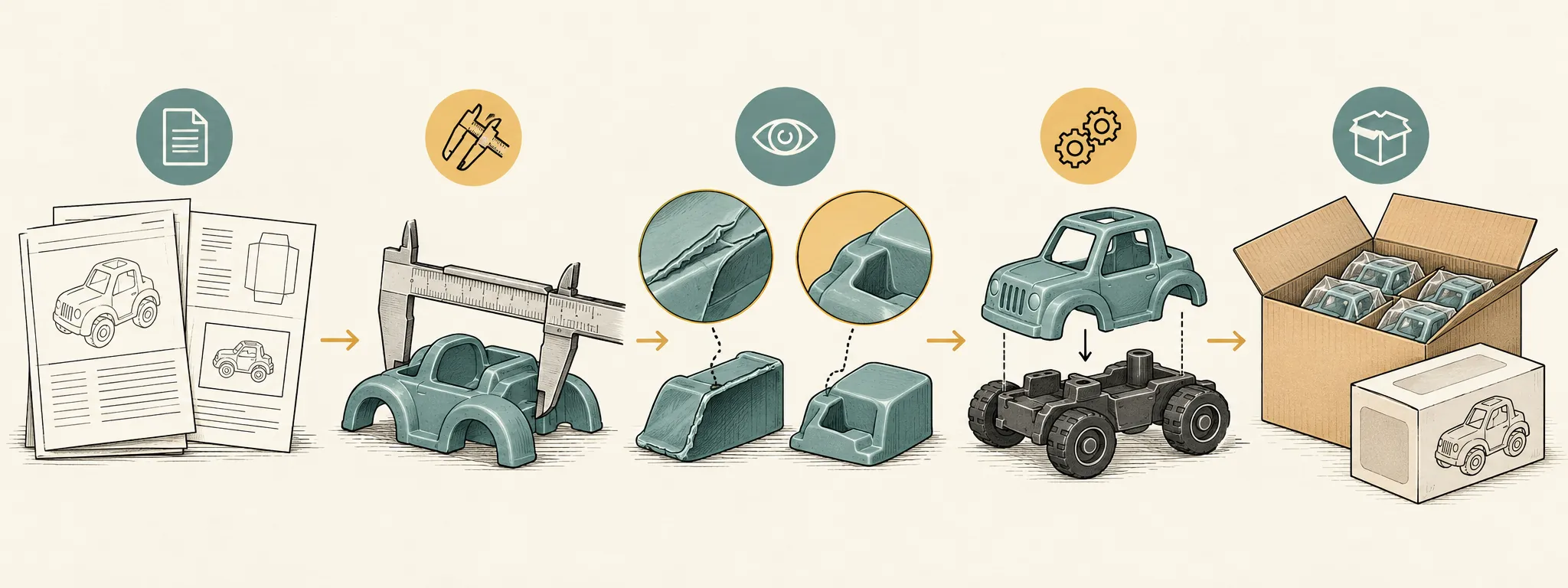
What must inspection of the final closed shipping carton confirm?
Final carton inspection should compare the actual packed carton with the approved packing specification, then resolve differences before the packing list is finalized.
Measure the outside of closed, normally packed cartons. Compare the readings with the approved dimensions and calculated CBM, checking for bulging or inconsistent closure. Use buyer-agreed dimensional tolerances rather than treating every small difference as a failed shipment. Record the measured result and decide whether to accept it within tolerance, correct the packing or revise the shipping figures.
Verify carton contents against the approved packing layout and unit definition, then close and reseal any cartons opened for inspection. Reweigh the closed carton for gross weight and verify net weight using the agreed contents basis. An unexplained count or weight discrepancy calls for a packing check and reconciliation before approval.
Check carton condition and construction against the approved specification: board construction, inserts, seams, closure and visible crushing or moisture damage. Where a strength requirement has been agreed, compare the relevant test result with that requirement. A carton that looks sound has not thereby demonstrated a specified strength rating.
Compare the shipping marks with the approved artwork and packing list. Check the buyer’s reference, item identity, quantity, carton numbering and any agreed handling marks. Incorrect or conflicting marks should be corrected and rechecked. Keep destination-specific paperwork requirements separate from this physical carton review.
When are the carton figures ready for shipment approval?
Carton figures are ready for shipment approval when final packed measurements, counts, weights and marks reconcile with the approved packing record and final packing list.
Keep proposed pre-PO data and final packed data as separate, dated versions. Reconcile the number of cartons, quantities in each packing configuration, any partial cartons, total units, gross and net weights, and total calculated CBM. Do not multiply one standard carton volume across cartons with different dimensions.
If inspection finds a difference outside the agreed tolerance, identify whether the carton needs repacking or the records need correction, then recheck the affected figures. Complete catalog fields support a quotation discussion; reconciled final packing records support the shipping decision. Neither replaces the separate product-safety release check.