









Choose wholesale RC cars by the specific model’s package fit and verified controls, not by scale alone. In this comparison, the 1:24 model offers the smaller listed retail package and a description centered on interchangeable drift tires; the 1:16 model offers a window box and T-Rex styling. Shortlist on those documented differences, then test steering, pairing and batteries before awarding control points. Neither scale label establishes speed, steering precision or suitability for multiple cars operating together.
The comparison below uses ToysBridge catalog references reviewed October 17, 2026: the 1:16 T-Rex model and the 1:24 drift model. Treat the figures as dated catalog specifications; confirm the current sample, retail pack and written quotation before placing an order.
What do the two catalog entries actually establish?
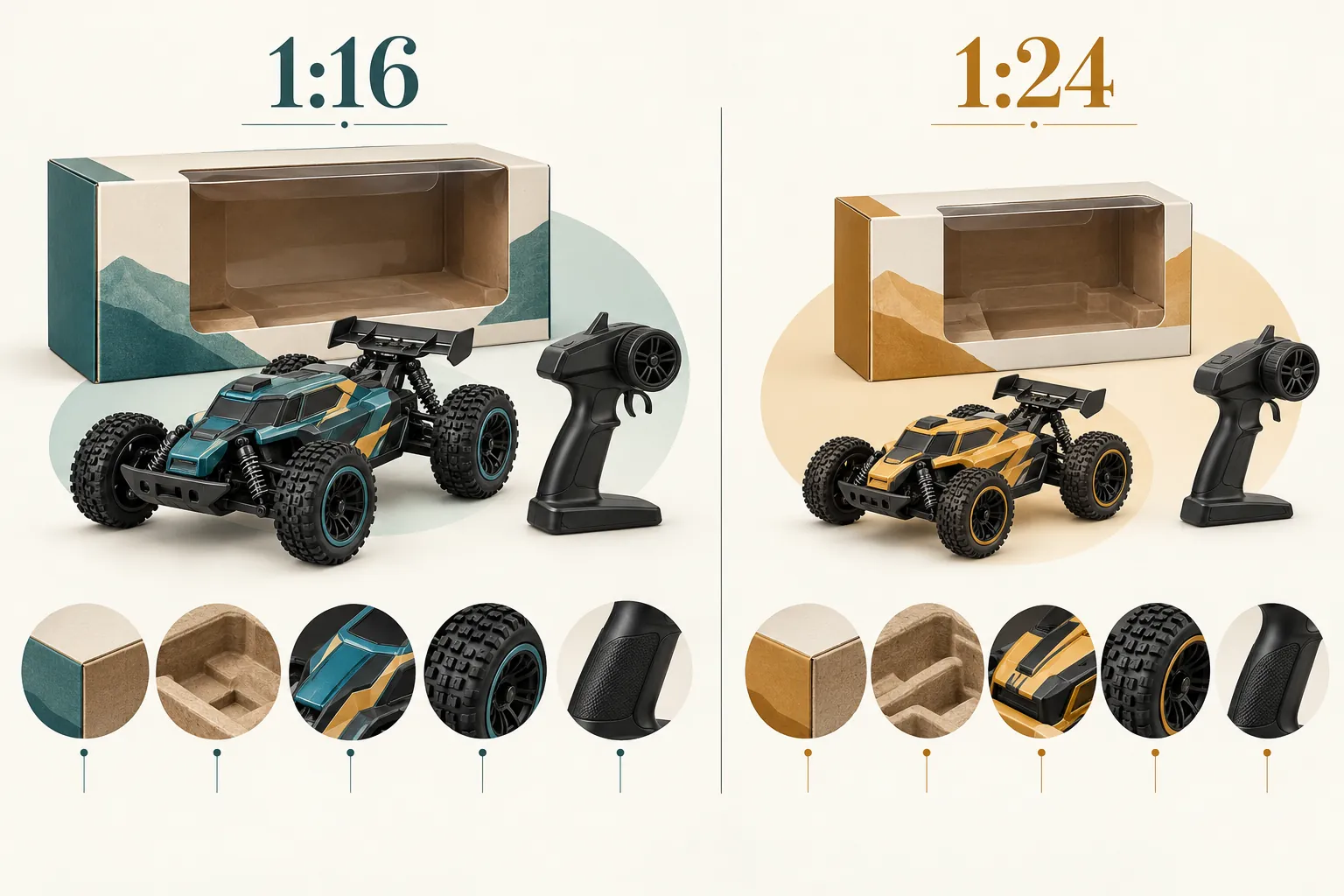
| Scale and styling | 1:16: T-Rex electric RC car. 1:24: RC racing/drift car. |
|---|---|
| Listed radio and movement features | 1:16: 2.4GHz remote control; forward, backward, left and right movement. 1:24: 2.4GHz, four-channel control; left/right steering drift function. |
| Other listed features | 1:16: dual motors, LED lights and rubber tires. 1:24: 4WD and two interchangeable tire types, described as smooth speed tires and drift tires. |
| Retail package type | 1:16: window box. 1:24: package field reads “Electricity box”; inspect the sample pack to establish its actual construction and presentation. |
| Retail package dimensions | 1:16: 28 × 14 × 11 cm. 1:24: 20.7 × 12.2 × 12.9 cm. |
| Export carton dimensions | 1:16: 70.5 × 56 × 66 cm. 1:24: 64 × 45 × 54.5 cm. |
| Units per export carton | 1:16: 60 units. 1:24: 40 units. |
| Carton gross/net weight | 1:16: 26/24 kg. 1:24: 20/18 kg. |
| Listed carton volume | 1:16: 0.26 m³. 1:24: 0.16 m³. |
How should buyers weight control, display and carton evidence?
Use a proposed 100-point scorecard with 50 points for control, 30 for display and 20 for carton fit. These are buyer-selected purchasing weights, not measured product scores or industry standards.
Rate each criterion from 0 to 5 against requirements written before sampling: 0 means it fails the requirement, 3 means it meets it, and 5 means it meets a defined preferred target. Calculate each contribution as criterion weight × rating ÷ 5. Leave untested criteria unscored rather than treating a catalog description as a passing result.
Assign the control category 20 points for steering and directional response, 15 for pairing and simultaneous operation, and 15 for the battery and charging arrangement. Allocate display points between package fit, worth 20, and physical presentation, worth 10. Split carton points equally between storage-space fit and handling fit.
Set hard gates separately. A package that cannot fit the intended fixture, or a control behavior that fails the purchase specification, should not be rescued by points earned elsewhere. Compare totals only after both samples have been assessed against the same criteria.
Which control checks belong on the samples?
Test steering, pairing and battery details directly; the shared 2.4GHz description does not establish that the two models behave alike.
For steering, use the same surface and starting conditions. Check forward and reverse travel, left/right response, return toward straight travel and controllability at low input. Establish whether steering and throttle are proportional or on/off. For the 1:24 model, compare both supplied tire types on the intended demonstration surface rather than assuming that a drift description proves the desired behavior.
For pairing, test startup with the car powered first and then with the transmitter powered first. Power-cycle each set and operate the intended number of cars together. Record unintended responses, lost connections and the steps needed to reconnect. Define the required number of simultaneous cars as a buyer criterion before testing.
For batteries, record the vehicle and transmitter battery types, quantities, inclusion status, compartment access, connector and charging arrangement. Check the instructions against the actual contents. Measure runtime or charging time only under a recorded procedure if those figures will influence the purchase.
These are commercial functional checks, not safety testing or certification. Do not convert scale, dual motors, 4WD or descriptive speed language into control points.
How does a package-fit requirement change the decision?
A defined package limit can favor the 1:24 model before either car earns a control score. Consider a buyer-entered requirement that the longest retail-package side must not exceed 25 cm; this is an illustrative fixture constraint, not a standard.
The listed 1:24 package has a longest side of 20.7 cm, so it passes that catalog screening requirement. The 1:16 package has a longest side of 28 cm, so it fails. If the buyer defines a passing footprint as a rating of 5, the 1:24 model provisionally earns the 20 footprint points and the 1:16 earns zero. Confirm those dimensions on the current pack before accepting the result.
That is a package-fit conclusion, not an overall product ranking. Where 28 cm is acceptable and visible product presentation is a purchase priority, the 1:16 window box deserves inspection. Check the viewing area, product restraint, accessory visibility and readable package panels; the words “window box” alone do not establish display quality.
Which carton figures should influence the choice?
Judge carton fit using both outer dimensions and packed quantity, not the smaller carton volume alone. The 1:24 carton is listed at 0.16 m³ with 40 units, while the 1:16 carton is listed at 0.26 m³ with 60 units.
For the storage-space score, check the confirmed carton dimensions against the intended rack, pallet or replenishment arrangement. For handling, assess the listed gross weights—20 kg for the 1:24 carton and 26 kg for the 1:16 carton—against the buyer’s handling procedure.
Neither set of figures establishes a freight-cost winner. Use the current pack and buyer-entered freight rates for that calculation; label the rates and charging basis as quotation assumptions. Packed quantity is also not, by itself, proof of a mandatory order multiple.
What should the buyer request before choosing?
Request both current samples with their intended retail packaging, then complete one shared scorecard before approving either model. Ask for confirmation of package and carton dimensions, units per carton, gross/net weights, battery contents and the quoted configuration.
Choose the 1:24 candidate when its smaller listed retail pack and interchangeable-tire format match the brief and its sample passes the control gates. Choose the 1:16 candidate when T-Rex styling and a window-box presentation are the intended offer, its package fits the fixture, and its controls pass the same checks. Scale is the catalog label; the purchase decision belongs to the verified configuration.